Privacy, Security, and Anonymity: Three Different Problems
About This Lesson
Most people use the words “privacy”, “security”, and “anonymity” as synonyms. They are not synonyms. Each word describes a different problem, and each problem has a different solution.
The confusion is not only a language problem. It causes operational failures. It ends engagements, it exposes cover identities, and it costs people their jobs.
This lesson gives you a precise definition of each concept. It shows you how the three concepts interact. It also shows you how to decide which concept is the most important one in a given situation.
Learning Objectives
After you read this lesson, you can do these tasks:
- Define privacy, security, and anonymity with technical precision.
- Explain the relationships and the trade-offs between the three concepts.
- Identify the scenarios where each concept is the primary concern.
- Apply the three concepts to real hacking scenarios.
Prerequisites
- Basic knowledge of information security.
- Basic knowledge of cybersecurity terminology.
1. The Three Definitions
Security
Security protects information and systems from unauthorized access, modification, or destruction. Think of a fortress: locks, alarms, and a hardened perimeter.
Security answers this question: Can a person break into this?
Example: you enable full disk encryption on your laptop. A thief takes the laptop. The thief cannot read your files without the key. This is security in operation.
Privacy
Privacy controls what you share and who can see it. Privacy includes data minimization, consent, and control of your digital footprint.
Privacy answers this question: What do I show, and to whom?
This is where many people make an error. You can have very good security and no privacy at the same time. You can use strong passwords and two-factor authentication on your mail account.
Now ask a different question about that fortress: who built it? You did not build it. You rent it. The provider owns the walls, and the provider keeps a key to every room. If your mail provider reads each message to select advertisements for you, no wall failed and no lock broke. The owner of the fortress opened a door and read your mail.
This is the point that people miss. Security defends against the persons outside the walls. It does not defend against the persons who own the walls. The security controls operate correctly. The privacy is gone.
Anonymity
Anonymity makes your actions untraceable. It disconnects what you do from who you are.
Anonymity answers this question: Can a person link this action to my true identity?
The Tor Browser is the usual example. The website that you visit does not know your true IP address or your identity. But Tor does not give you security or privacy automatically. If you sign in to your personal social media account through Tor, you identify yourself. The anonymity is lost.
2. How the Three Concepts Overlap
The three concepts overlap, and the overlaps are where the useful lessons are.
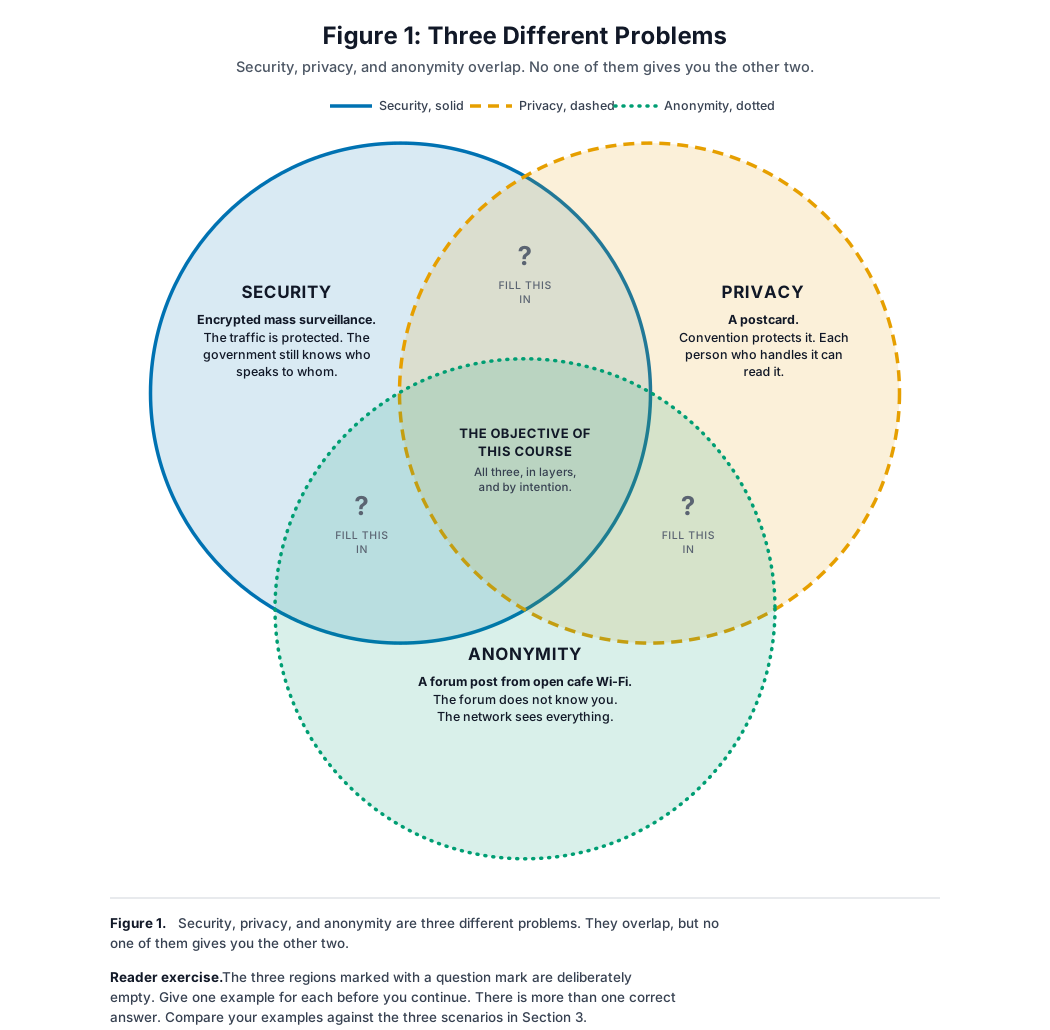
Figure 1. Security, privacy, and anonymity are three different problems. They overlap, but no one of them gives you the other two.
Reader exercise. Three regions of Figure 1 are deliberately empty. Give one example for each empty region before you continue. There is more than one correct answer. Compare your examples against the three scenarios in Section 3.
Security without privacy. A government surveillance system uses strong encryption. No third party can intercept the communications. But the government still knows who speaks to whom, when, and how frequently. The security is good. The privacy is zero.
Privacy without security. A postcard is the example. Social convention says that only the addressee reads it. But each person who touches that postcard can read it. This is privacy by honor system, with no security control.
Anonymity without security. You make a forum post from an open cafe Wi-Fi network. The forum does not know who you are. But you transmit cleartext to each other user on the same network.
The objective of this course is all three, in layers, and by intention.
Answer Key for Figure 1
Do the reader exercise before you read this part.
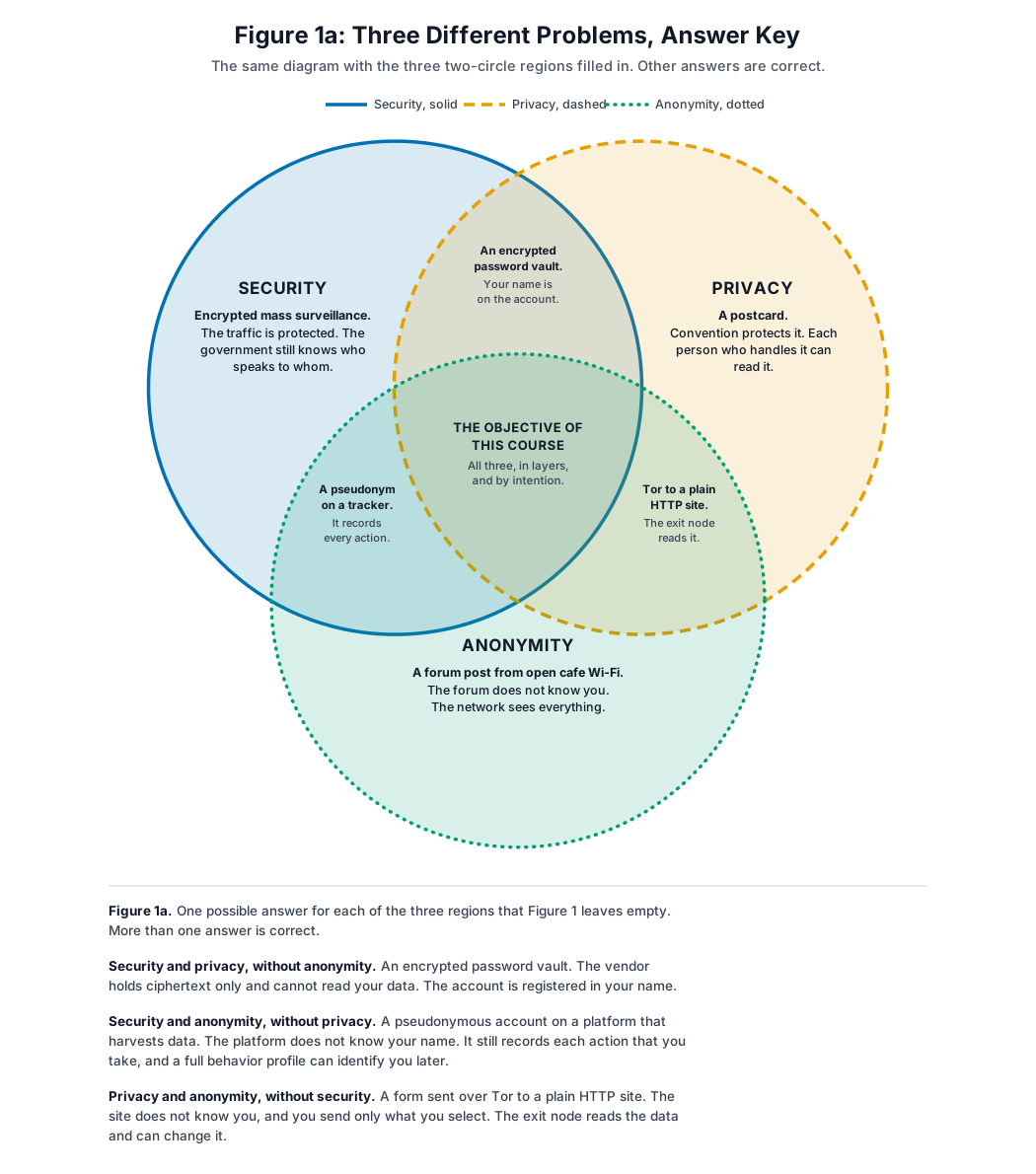
Figure 1a. One possible answer for each empty region. More than one answer is correct.
| Region | Example | Why it goes there |
|---|---|---|
| Security and privacy, without anonymity | An encrypted password vault | The vendor holds ciphertext only and cannot read your data. The account is registered in your name, so the activity is fully attributable. |
| Security and anonymity, without privacy | A pseudonymous account on a platform that harvests data | Transport encryption protects the session and the platform does not know your legal name. It still records each action that you take. A full behavior profile can identify you later. |
| Privacy and anonymity, without security | A form sent over Tor to a plain HTTP site | The site does not know you, and you send only the data that you select. The last hop is cleartext, so the exit node reads the data and can change it. |
The second row is the most important one. Anonymity does not stop data collection. It only removes the name from the data. A sufficiently detailed behavior profile can attach the name again.
3. Why the Distinction Is Important for Hackers
The correct priority order changes with the task. These three scenarios show how much it changes.
Scenario 1: Bug Bounty Hunting
You do reconnaissance on a target. You need all three concepts:
- Anonymity, so that your initial research is not immediately attributable to you.
- Security, to protect your notes, your tools, and your proof-of-concept code from competitors.
- Privacy, so that the company cannot profile your research pattern and infer your target.
If you lose one of the three, the work degrades. Without anonymity, the security team sees a pattern, classifies it as hostile, and hardens the target before you find a defect. Without security, your proof-of-concept code leaks and a different researcher submits it first. Without privacy, the company correlates your activity across multiple endpoints and learns exactly what you examine.
Safety warning. Many formal bug bounty programs require the opposite behavior. A program can require you to add a custom identification header to your traffic, to register your source IP addresses before you start, or to obey a rate limit. Some programs prohibit Tor and anonymizing proxies. Read the program policy before you send the first request. The instinct for anonymity is correct in principle. It is incorrect at the moment that it breaks the scope agreement that you accepted. A scope violation can remove you from the program. (Reference 6, Reference 7)
Scenario 2: Red Team Operation
This scenario is a physical penetration test. The priorities change:
- Anonymity is the primary concern. Personnel must not identify you as the person who came through the door.
- Security protects your command and control infrastructure.
- Privacy stops your operational communications from showing the plan.
In physical work, anonymity usually has the highest priority. Your command and control server can be fully hardened. But if the camera system records a clear image of your face, and a guard escalates before your authorization letter is produced, the operation stops. The most secure tool in your bag cannot protect you from a lobby camera.
Safety warning. Always carry your written authorization letter during a physical engagement. Also carry the contact details of your primary and secondary client points of contact.
Scenario 3: Malware Analysis
The threat model is fully different:
- Security is critical. Use an isolated environment. Give the sample no escape path.
- Privacy is important, so that your analysis activity does not signal the malware author.
- Anonymity is frequently less important. The exception is research into nation-state actors, who can have an interest in the identity of the analyst.
These are the same three concepts in a fully different priority order. The skill is the change of context. Practice it.
4. The Trade-offs
You cannot maximize all three concepts at the same time. The trade-offs are real.
Security against usability. The most secure system is a system that no person can access, and that includes you. Each control that you add causes friction. This is not a defect in the design. Plan for it.
Anonymity against functionality. True anonymity costs you speed and convenience. Tor is slower than a direct connection. An anonymous account has no password recovery path. There is no “remember me” function when you do not want to be remembered.
Privacy against features. Many convenience features require the provider to read your data. Server-side search, automatic categorization, and predictive composition all need access to plaintext. Proton Mail cannot index your inbox on its servers in the same way as Gmail, because Proton Mail cannot read the inbox. That is the trade.
This trade is becoming more subtle, but it does not go away. Proton now supplies a writing assistant, Proton Scribe, that can operate fully on your local device. As an alternative, it can operate on Proton no-logs servers, where the prompts are encrypted in transit and are deleted after use. Proton says that it does not use this data for model training. (Reference 4, Reference 5)
Do not make assumptions about a feature. Examine where the processing occurs.
Table 1: The Trade-off Matrix
Use this table when you select a tool or a control. The last column is the question that makes the trade visible before you accept it.
| Trade-off | What you gain | What you pay | Question to ask first |
|---|---|---|---|
| Security against usability | Protection from unauthorized access | Friction at each use, and a risk that you lock yourself out | Can I still do my work with this control in position? |
| Anonymity against functionality | Actions that do not link to your identity | Speed, convenience, and the account recovery path | What happens to this account if I lose the credential? |
| Privacy against features | A provider that cannot read your data | Server-side search, categorization, and prediction | Where does the processing occur, on my device or on their server? |
No row in this table has a correct answer that applies to all situations. The correct answer changes with the task, as Section 3 shows. The error is to accept a row without a decision.
Write this principle down: you must decide which trade-offs you make, and you must decide consciously. The worst privacy failures do not occur because a person made the wrong choice. They occur because the person did not know that there was a choice.
Threat modeling is the method that makes the choice visible. Lesson 4 covers threat modeling.
5. Four Myths to Remove
Myth 1: “I have nothing to hide, so I do not need privacy.”
This confuses privacy with secrecy. It assumes that a wish to keep something unseen is proof of misconduct. You close the bathroom door, but not because you do the wrong thing there. Some things are simply yours.
As an ethical hacker, you hold client data, active research, and professional obligations. Privacy is necessary independently of the legality of your work.
Myth 2: “A VPN makes me anonymous.”
It does not. A VPN gives you some privacy from your internet service provider. It gives you security on an untrusted network. But the VPN provider still knows who you are. You are not anonymous. You only moved the party that you must trust.
Myth 3: “Strong encryption gives complete privacy.”
Encryption protects the content of a message. Content protection is a security control. Metadata usually leaks: who you contact, when, how frequently, and from where. Metadata alone is frequently sufficient to reconstruct a person’s life in detail.
Be precise here, because much privacy advice is wrong on this point. Signal is the counterexample, not the warning. Signal minimizes metadata by design. Sealed sender hides the sender identity from the Signal servers. In response to a grand jury subpoena, Signal supplied only two data items: the account creation timestamp and the last connection timestamp. (Reference 1, Reference 2, Reference 3)
Most encrypted messengers do not operate in this manner. WhatsApp uses the same underlying encryption protocol, but it keeps much more metadata. A 2021 FBI document shows that WhatsApp can supply metadata for a target user every 15 minutes in response to a pen register order. With a search warrant, WhatsApp can also supply the address book contacts of the target, and the details of other users who have the target in their contacts. (Reference 8, Reference 9)
End-to-end encryption tells you that the content is protected. It tells you nothing about the data that the service keeps around the content. These are two different questions. Ask both.
Myth 4: “Open source means secure.”
Open source makes an audit possible. It does not prove that an audit occurred.
The Heartbleed defect (CVE-2014-0160) is the example. The defective code entered OpenSSL on 31 December 2011 and shipped in OpenSSL 1.0.1 on 14 March 2012. Researchers reported it publicly on 7 April 2014, which is more than two years later. The fix shipped in OpenSSL 1.0.1g on 8 April 2014. (Reference 10, Reference 11)
Open source is a necessary condition for verifiable security. It is not a sufficient condition.
6. Summary
- Security protects data from unauthorized access.
- Privacy controls what you share and who sees it.
- Anonymity makes your actions untraceable.
The three concepts overlap, they interact, and they trade off against each other. Your task as an ethical hacker is to know which concept has the highest priority in a given context. Make that decision on purpose, not by accident.
Action item. Examine your current workflow before you continue. Where do you use security? Where do you need privacy? Where does anonymity actually apply? Write the answers down. The course builds on this self-assessment.
The next lesson covers digital footprints: the data trails that we leave continuously, usually without knowledge of it.
Knowledge Check
Question 1. Which statement best describes the relationship between security and privacy?
- A) They are the same thing.
- B) They are related but different concepts, and each one can exist without the other.
- C) Privacy always requires anonymity.
- D) Security is a prerequisite for privacy.
Answer: B. You can have secure systems without privacy, as in encrypted government surveillance. You can have privacy without security, as with a postcard.
Question 2. A penetration tester uses the Tor Browser to research the infrastructure of a target company. Which concept is the primary one?
- A) Anonymity
- B) Confidentiality
- C) Privacy
- D) Security
Answer: A. Tor primarily gives anonymity, because it hides the true IP address and the identity of the tester.
Question 3. You enable full disk encryption on your laptop. This is primarily a _____ control.
- A) Privacy
- B) Confidentiality
- C) Anonymity
- D) Security
Answer: D. Encryption prevents unauthorized access to data, which is a security function.
Question 4. Which scenario shows privacy without security?
- A) Use of Tor to browse a personal social media account
- B) Encrypted mail that the provider scans for advertising
- C) A postcard sent through the mail
- D) Use of a VPN on public Wi-Fi
Answer: C. A postcard has privacy by social convention and no security, because each person who handles it can read it.
Question 5. As a bug bounty hunter, why can you need anonymity during initial reconnaissance?
- A) To prevent the company from tracking your research patterns
- B) To obey the rules of the bug bounty program
- C) To prevent a block, or an unnecessary alert to the security team
- D) Both A and C
Answer: D. Anonymity prevents pattern tracking and early detection during reconnaissance. Note the exception in this lesson: many formal programs require attributable traffic, such as registered source IP addresses and identification headers. The program policy has priority over the general principle.
Question 6. Which statement about VPNs is the most accurate?
- A) A VPN primarily gives privacy from the internet service provider and some security on untrusted networks.
- B) A VPN removes all metadata.
- C) A VPN gives complete anonymity.
- D) A VPN is unnecessary if you have strong encryption.
Answer: A. A VPN gives privacy and security benefits, but it does not give true anonymity.
Question 7. Metadata leakage from encrypted communications is a failure of:
- A) Security only
- B) Anonymity only
- C) Privacy only
- D) Both security and privacy
Answer: C. The encryption, which is the security control, operates as designed. The metadata shows communication patterns, which is a privacy failure.
Question 8. In a red team physical penetration test, which concept usually has the highest priority?
- A) Security, which is protection of tools and infrastructure
- B) Anonymity, which is protection against identification
- C) Privacy, which is concealment of operational methods
- D) All three have equal priority
Answer: B. Physical identification can compromise a full operation immediately and permanently.
Question 9. The “I have nothing to hide” argument confuses:
- A) Security with obscurity
- B) Encryption with security
- C) Anonymity with privacy
- D) Privacy with secrecy
Answer: D. Privacy is a right that does not depend on the legality of your actions.
Question 10. Open source software automatically gives:
- A) The ability to verify the code, but not guaranteed security
- B) Security through public audit
- C) Complete anonymity
- D) Privacy by default
Answer: A. Open source makes an audit possible, but it does not prove that an audit occurred. Heartbleed is the example.
Exercise: Self-Assessment Worksheet
Complete this self-assessment before you continue. It records your current privacy posture.
Part 1: Daily Workflow Analysis
Rate your current implementation for each activity, from 1 to 5:
- 1 = No consideration
- 3 = Some awareness, or basic controls
- 5 = Complete and intentional implementation
| Activity | Security | Privacy | Anonymity | Notes |
|---|---|---|---|---|
| Mail communications | ___ | ___ | ___ | |
| Web browsing | ___ | ___ | ___ | |
| File storage | ___ | ___ | ___ | |
| Instant messaging | ___ | ___ | ___ | |
| Password management | ___ | ___ | ___ | |
| Online research | ___ | ___ | ___ | |
| Code repositories | ___ | ___ | ___ | |
| Social media | ___ | ___ | ___ |
Part 2: Scenario Planning
For each scenario, identify the most critical concept: security, privacy, or anonymity.
- Storage of client penetration test reports: _____________
- Research into zero-day vulnerabilities: _____________
- Communication with a bug bounty program: _____________
- Attendance at a hacker conference: _____________
- Publication of security research on your blog: _____________
Part 3: Threat Modeling Preview
Answer these questions accurately. Lesson 4 builds on the answers.
-
Who has an interest in your activities? List the possible adversaries.
-
-
Which information do you most want to protect?
-
-
What are the consequences if this information becomes public?
-
-
How much time, money, or convenience will you trade for protection?
-
Part 4: Gap Analysis
From your answers above, write your three largest privacy gaps.
Keep this worksheet. You will do it again at the end of the course to measure your progress.
Additional Resources
Recommended Reading
- Permanent Record, Edward Snowden. Privacy concepts from a person who lived them.
- The Art of Invisibility, Kevin Mitnick. Practical privacy from the perspective of a hacker.
- Electronic Frontier Foundation, Surveillance Self-Defense: https://ssd.eff.org
Tools to Examine Before the Next Lesson
- Privacy Badger, a browser extension from the Electronic Frontier Foundation: https://privacybadger.org
- Cover Your Tracks, previously Panopticlick. It tests your browser fingerprint: https://coveryourtracks.eff.org
- OSINT Framework. Use it to find what is publicly available about you: https://osintframework.com
Discussion Questions
- Give a scenario where you would deliberately give privacy a higher priority than security.
- How does your current employer or client protect the privacy of penetration test findings?
- Name one privacy practice that you know you must implement, but that you continue to ignore.
References
- Signal, Grand jury subpoena for Signal user data, District of Columbia
- SecurityWeek, Signal Provides Only Two Timestamps as Response to Grand Jury Subpoena
- Gizmodo, Confused Feds Subpoena Signal for Data It Does Not Collect
- Proton, Introducing Proton Scribe, a private writing assistant
- Engadget, Proton Mail now has a privacy-focused AI writing assistant
- Atmail, Bug Bounty Program Policy, source IP and X-Bug-Bounty header requirements
- Tor Project bug bounty program, HackerOne
- Just Security, We Now Know What Information the FBI Can Obtain from Encrypted Messaging Apps
- Rolling Stone, FBI Document Says the Feds Can Get Your WhatsApp Data in Real Time
- CISA, OpenSSL Heartbleed vulnerability CVE-2014-0160
- Heartbleed Bug, official information site